
It is getting hot in here, Understand your Investment Risk Tolerance
Some people can eat a raw chilli without flinching. Others feel the burn before it even reaches their lips. Investment risk works in much the same way and understanding where you sit on that spectrum could be one of the most valuable things you ever do with your finances.
The Scoville Scale, and What it Has to Do With Your Money
If you have ever studied the label on a bottle of hot sauce, you may have come across the Scoville scale. It is the standard measure of chilli heat, running from zero for a mild bell pepper all the way up into the millions for the fiery Carolina Reaper. Named after pharmacist Wilbur Scoville, who devised the test in 1912, it gives chilli lovers a reliable guide to how much heat they are likely to encounter.
Investors have their own version of this scale. In financial planning it is called risk tolerance or risk profile and it measures something equally personal, how much uncertainty you can stomach when it comes to your money.
Just as no two people experience chilli heat in exactly the same way, no two investors experience market movements identically. What feels manageable to one person can feel deeply alarming to another, and the science backs this up. Perception of risk, much like perception of spice, is shaped by personality, experience, knowledge and even the circumstances of your life at any given moment.
| “Understanding your own risk tolerance is not about being bold or being cautious. It is about being honest with yourself.” |
Not Everyone Can Tolerate the Same Level of Heat
Walk into almost any restaurant that serves bold, spiced food and you will notice the menu carries warnings. A little chilli symbol here, a note about “fiery dishes” there. The kitchen does not assume every diner wants the same level of heat. It gives you the information, and you choose.
Good financial planning works in precisely the same way. A qualified financial planner will not assume you are comfortable with any particular level of risk simply because it might produce a higher return. They will work with you to understand your circumstances, your goals, your timeline and your emotional response to the idea of your investments falling in value, even temporarily.
Some clients know straight away that they are low-risk investors. The very thought of market volatility makes them uncomfortable. For them, a portfolio weighted heavily towards lower-risk assets such as bonds, fixed income or cash-equivalent funds might be entirely appropriate. Others are confident risk-takers who are comfortable watching their portfolio move up and down in value, knowing that over the long term they are aiming for stronger growth.
Most people sit somewhere in the middle, and that is perfectly normal.
| Common Investor Risk Profiles at a Glance
• Cautious, seeking capital preservation above all else • Moderately cautious, comfortable with limited fluctuation • Balanced, aiming for steady growth with manageable risk • Moderately adventurous, prioritising growth over short-term stability • Adventurous, accepting significant volatility in pursuit of higher long-term returns |
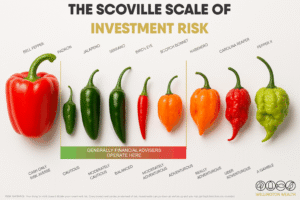
The Scoville Scale of Investment Risk
To bring this to life, consider the following rough guide. It is not a rigid system, but it may help you begin to think about where your own appetite for risk sits.
| The Chilli | Investor Profile | What it means for your money |
| Bell Pepper | Risk averse | Cash Only be wary of inflation |
| Padron | Risk Level 1 | Very cautious investor, mainly cash and bonds |
| Jalapeno | Risk Level 2 | Capital preservation with modest growth potential |
| Serrano | Risk Level 3 | Balanced approach, comfortable with some fluctuation |
| Bird Eye | Risk Level 4 | Growth-oriented, accepts meaningful market swings |
| Scotch Bonnet | Risk Level 5 | Aggressive growth, high volatility accepted |
| Habanero | Really Adventurous | Exceptionally high growth, very high volatility, capital could be at risk |
| Carolina Reaper | Uber Adventurous | Top level of risk hard to determine, extremely high volatility, capital at high risk of loss |
| Pepper X | Complete Gamble | You could lose it all or sh*t yourself. Never put all your savings here! |
It is worth remembering that these categories are starting points, not fixed destinations. Your risk profile can shift over your lifetime and a good financial planner will revisit it with you regularly.
Some People Do Not Know Their Own Tolerance Until They Are Tested
One of the most common challenges in financial planning is that many investors genuinely do not know how they will respond to market falls until they experience one. A client might sit down, complete a risk questionnaire and select a balanced or even adventurous profile, only to feel real anxiety when markets dip and their portfolio value drops.
This is not a failure on anyone’s part. It is simply a reflection of the fact that our theoretical tolerance for risk and our emotional tolerance for it can be quite different things. Knowing this in advance and planning for it, is part of what a good adviser is there to help you with.
Think of it like visiting a chilli farm for the first time. You pick up a pepper and it looks manageable, perhaps a little Serrano. You take a bite, and within seconds you realise it was considerably hotter than you anticipated. You reach for the water, and you learn something about yourself.
Investment markets have a habit of doing the same thing.
| “Your emotional response to a falling market matters just as much as the numbers on your risk assessment form.” |
Do Not Go All In at the Hottest Level
One piece of advice that holds true in both the kitchen and the investment world: do not go straight for the Carolina Reaper.
It can be tempting, particularly when markets are performing strongly, to want a slice of the action. You see news stories about remarkable returns in a particular sector or asset class and it feels like everyone else is enjoying a feast while you sit cautiously to one side. This is a well-documented phenomenon in behavioural finance known as recency bias, the tendency to believe that recent performance will continue indefinitely. It is the reason why any regulated firm must put a risk warning.
Every investment carries an element of risk, markets can go down as well as up and you could get back less than you invested.
Moving your entire portfolio into high-risk assets because of recent good news is the financial equivalent of ordering the hottest dish on the menu just because the person at the next table seemed to enjoy it. Their tolerance may be very different from yours, their circumstances almost certainly are and the consequences of misjudging it can be severe.
A slow, considered build is far more sustainable. If you genuinely believe you could tolerate a little more risk over time, the right approach is a gradual increase, underpinned by knowledge and a clear understanding of why you are making the change. Your financial planner is there to guide that process with you.
Pepper X: When an Investment Goes Beyond the Scale Entirely
If the Carolina Reaper sits at the top of our five-point scale, there are investments in the world that sit somewhere beyond it entirely. In the chilli world, that place belongs to Pepper X.
Pepper X was created by Ed Curlin of the PuckerButt Pepper Company in South Carolina and in 2023 it was certified by Guinness World Records as the hottest chilli on the planet, registering at an extraordinary 2.69 million Scoville units. To put that in perspective, the Carolina Reaper, which most people would consider an extreme experience, measures around 1.6 million. Pepper X does not just raise the bar. It shatters it and investing so recklessly could shatter you.
In the investment world, cryptocurrency occupies a similar position. It sits beyond the conventional risk scale, not because it cannot produce extraordinary returns, but because the volatility, the unpredictability and the potential for total loss place it in a different category from mainstream investment assets. Bitcoin, for example, has at various points lost more than eighty per cent of its value within a single year, before recovering dramatically, before falling sharply again. For most investors, that is not a risk profile. That is a white-knuckle experience that could end very badly indeed.
This does not mean that Pepper X has no place at the table. It means it has a very specific and carefully considered place. A skilled chef might place a small bottle of Pepper X sauce on the side for those diners who genuinely know what they are doing, who have built up their tolerance over many years and who want to add a controlled amount of additional heat to an already well-balanced dish. The bottle is there. It is not the dish.
The same principle applies in financial planning. If you have a solid, well-constructed portfolio that is already working appropriately for your goals, and if you have a genuine understanding of the risks involved, then a small, ring-fenced allocation to something like cryptocurrency, sized in a way that you could afford to lose entirely without it affecting your financial plan, might be something worth discussing with your adviser. A small bottle on the side. Not a pot made entirely from Pepper X.
Because if you invited your friends round for dinner and served a meal made entirely from Pepper X, the evening would not go well. You would not be able to eat it. The experience would be overwhelming and potentially quite unpleasant. Nobody would be coming back for seconds, and the evening would be remembered for all the wrong reasons.
Building a financial future on extreme, unbalanced risk works in exactly the same way. The stories of people who made a fortune overnight in cryptocurrency are real, but so are the stories of those who lost everything. The difference, in most cases, was not luck. It was whether they were treating it as the whole meal or as a carefully considered condiment.
| “A small bottle of Pepper X on the side is an interesting addition. A pot made entirely from it is a very different proposition.” |
| Questions Worth Asking Yourself Before Increasing Investment Risk
• How would I feel if my portfolio fell by 10% in a single month? • Do I have sufficient cash reserves to meet my needs without touching my investments? • Am I investing for the long term, giving my portfolio time to recover from downturns? • Have I taken professional financial planning advice specific to my own situation? • Is my decision based on my own goals, or am I reacting to short-term market noise? |
You Do Not Need to Know Every Chilli on the Planet. You Just Need to Know Yourself.
Here is something that stops many people from engaging with their finances as fully as they should. They believe they need to understand every investment fund, every asset class, every market and every economic signal before they can have a meaningful conversation about their money. They feel, quite understandably, that they are not qualified to have the discussion.
They are wrong and this matters.
Think again about the restaurant. When you sit down to eat, you do not need to know how to source, prepare or balance every ingredient on the menu. You do not need a culinary qualification to decide whether you prefer mild, medium or fiery. That knowledge belongs to the chef. Your job is simply to know your own palate and to communicate it honestly.
A professional financial planner works in exactly the same way. The team at Wellington Wealth spend their days immersed in markets, funds, asset allocation, risk-adjusted returns and the full complexity of the investment universe. That is their job and they are exceptionally good at it. Your job is not to replicate that knowledge. Your job is to understand yourself well enough to tell them how you feel.
Can you comfortably watch the value of your investments fall by fifteen per cent in a difficult quarter, knowing it is likely to recover over time? Or does that kind of movement keep you awake at night? Do you feel your portfolio is working hard enough for you, or does it feel like it is sitting too cautiously while inflation quietly erodes its value? These are not technical questions. They are personal ones. They are questions about your life, your plans and your peace of mind.
A good financial planner will ask you questions like these, listen carefully to your answers and then translate that into a portfolio built precisely around your needs. The technical work, the fund selection, the asset allocation, the rebalancing and the ongoing monitoring all sit firmly with them. What they need from you is honesty about how you are feeling and if it is not right flag this.
| “The chef handles the kitchen. You handle your palate. Between you, the meal gets it exactly right.” |
When it Gets Too Hot, Say So. When it Is Not Hot Enough, Say That Too.
Your role in the relationship with your financial planner does not end once the initial advice is given and the portfolio is in place. Life changes. Circumstances shift. What felt entirely comfortable eighteen months ago may feel very different today, for all sorts of reasons that have nothing to do with the markets.
Perhaps your employment situation has become less secure. Perhaps you have had a significant change in your family circumstances, an inheritance, a divorce, the arrival of a child or grandchild, or the realisation that retirement is now closer than it once seemed. Perhaps you have simply become more cautious with age, or conversely, a period of stability has given you the confidence to consider taking on a little more risk in pursuit of stronger long-term growth.
None of these conversations should feel awkward or embarrassing. Your financial planner is not there to judge your feelings about money. They are there to work with those feelings and translate them into a strategy that serves you well.
If your current portfolio level is making you uncomfortable, tell them. If you feel it is too cautious for where you are in life right now, tell them that too. The communication goes both ways, and a good planner will check in with you regularly, precisely because they know that risk tolerance is not a fixed point on a diagram. It is a living, breathing thing that moves with you through your life.
The only mistake you can make is staying silent. A dish that is too hot, endured in polite discomfort when you could simply have asked for it to be adjusted, is nobody having a good time. The same applies to an investment portfolio that is not sitting right with you.
| “A portfolio should fit your life, not the other way around.” |
The Restaurant That Gets the Balance Right
Most good restaurants do not serve everything at the hottest level. They calibrate their menu carefully, offering something for every palate, with clear guidance to help you choose. They want you to enjoy your meal, to leave feeling satisfied rather than overwhelmed and to come back.
A good wealth management practice works on the same principle. The goal is not to take the maximum amount of risk in pursuit of the highest possible return. The goal is to build a portfolio that is right for you, that supports your financial objectives, that you can sustain over the long term and that lets you sleep at night.
Wellington Wealth has been built on exactly that philosophy, one that places the person before the portfolio, and understands that everyone’s appetite for financial risk, like their appetite for chilli, is entirely their own.
If you fancy a conversation with us contact us here >>>
Please note your liking for chilli has no bearing on your investment risk always treat separately!!
BE AWARE
This information is for guidance only and does not constitute regulated financial advice. To ensure you have personalised advice for your particular set of circumstances, you must make an appointment and speak to one of our professional advisers. Please note these services are chargeable. The facts in this article were correct at time of writing, but you may be reading it in the future. Always check rates and allowances before taking action or speak to a qualified financial planner. All investments carry an element of risk, they can fall as well as rise and you may not get back what you pay in. Errors & omissions excepted.
#TheScovilleScaleofInvestmentRisk #RiskTolerance #RiskAwareness #Investment